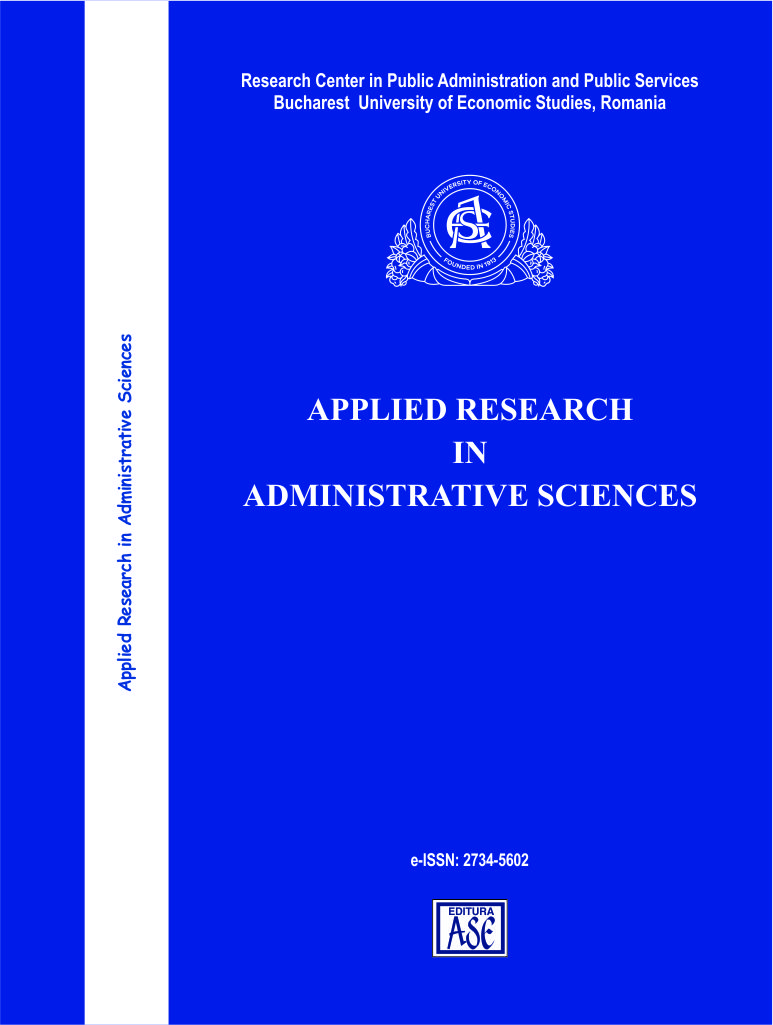
ISSN: ISSN: 2734-5602
ISSN-L: 2734-5602
Publisher:
Editura ASE, Publishing House of The Bucharest University of Economic Studies
Reg.no: 4433775
POLICIES & LICENSES
Applied Research in Administrative Sciences (ARAS) publishes original, interdisciplinary research employing innovative methods for data collection, analysis, and interpretation. The journal focuses on topics including public administration, public management, public policy, strategic and quality management, human resources, project and urban management, information management, change management, digital transformation, administrative law, regulatory governance, public law and institutional frameworks and comparative administrative systems and NGO management.
The ARAS journal is published three times a year:
- Issue 1 – April;
- Issue 2 – August;
- Issue 3 – December.
Manuscripts together with the agreements may be submitted throughout the year, preferably until the end of February, the end of June and the end of October to the e-mail address of the journal: arasjournal@ase.ro
Submissions must be original, contribute significantly to the field, and align with the journal’s scope. All manuscripts must be accompanied by the ARAS Publishing Agreement Form and the ARAS Copyright and Ethics Agreement Form, available on the journal website. The authors have to download them from the journal website, fill in, sign, scan and send them together with their manuscript.
All submissions to Applied Research in Administrative Sciences (ARAS) are initially screened by the Editorial Board. Manuscripts may be: (a) sent for peer review, (b) returned to authors for revision, or (c) rejected if outside the journal’s scope. The responsible editor evaluates each manuscript for relevance, originality, adherence to formatting and style guidelines, language quality, and proper citation according to APA standards.
Following a positive preliminary assessment, manuscripts undergo peer review. Final decisions are based on reviewer feedback and the manuscript’s alignment with the journal’s priorities. The Editorial Board reserves the right to reject submissions at any stage.
Post-publication errors are corrected via erratum, retraction, or dated in-line corrections. Authors and readers are encouraged to report errors. Retractions occur in cases of unethical research, unreliable data, misconduct, plagiarism, or major errors that invalidate the article.
Authorship should be attributed only to individuals who have provided a meaningful intellectual contribution to both the research process and the development of the manuscript. All listed authors are expected to share responsibility for the integrity of the work and to approve the final version prior to publication. Contributors who do not meet the criteria for authorship but have supported the study or the preparation of the manuscript should be recognized in the Acknowledgements section, positioned before the References.
It is the responsibility of the authors to secure authorization for the use of any material previously published or produced by third parties, including figures, tables, or excerpts of text. If requested by the Editorial Office or the Publisher, authors must provide appropriate documentation demonstrating that such permissions have been obtained.
Modifications to the authorship list are not permitted once the manuscript has entered the peer-review stage or after it has been formally accepted for publication.
Guidelines regarding manuscript formatting and submission procedures are provided in the Information for Authors section.
The ARAS Editorial Board, together with the Scientific Committee, considers that authorship should be attributed only to individuals who have played a meaningful intellectual role in the development of the study. Such contribution may include involvement in the conceptualization or design of the research, participation in the collection or processing of empirical material, or engagement in the interpretation of the results. In addition, authors are expected to take part in the preparation of the manuscript, either through writing sections of the text or through substantive academic revisions.
All authors must review and formally approve the final version of the manuscript before publication. By accepting authorship, each contributor also assumes responsibility for the reliability and integrity of the work and agrees to cooperate in clarifying or resolving any issues related to the accuracy of the research or its presentation.
Submitting authors must ensure that the manuscript represents original scholarly work and that it has not appeared previously in another publication, including in substantially similar form. The manuscript must be submitted exclusively to this journal and must not be simultaneously considered, reviewed, accepted, or published by another outlet. Furthermore, the content of the submission must comply with legal and ethical standards and must not include material that could be interpreted as defamatory, fraudulent, abusive, or otherwise unlawful.
Confirmation of compliance with these ethical and legal obligations is provided through the ARAS Copyright & Ethics Agreement Form. This document must be completed and signed individually by all authors. A scanned copy (PDF or JPG) should be submitted together with the manuscript and the ARAS Publishing Agreement Form to the editorial office using the contact details provided.
Failure to adhere to these requirements constitutes a violation of publication ethics. In such situations, the publisher reserves the right to decline the submission and, where necessary, to apply appropriate sanctions to the authors involved.
Members of the ARAS review panel are required to disclose any potential conflicts of interest related to the manuscripts they evaluate. Prior to submitting their assessment, reviewers must confirm whether any personal, professional, or institutional relationship with the authors could influence the objectivity of the review process. When a conflict is identified by the reviewer or detected by the editorial board, the manuscript will be reassigned to an alternative reviewer in order to ensure an impartial evaluation.
The ARAS Editorial Board promotes high standards of research integrity as an essential principle of scholarly publication. To safeguard these standards, all submitted manuscripts undergo a similarity screening during the initial editorial assessment, prior to the scientific peer-review stage.
For this purpose, the editorial team employs a specialized plagiarism detection system available at https://www.sistemantiplagiat.ro/, operated under a license held by the Bucharest University of Economic Studies. The software evaluates submitted manuscripts by calculating two similarity indicators, referred to as C1 and C2. The C1 coefficient represents the proportion of text containing sequences of at least five consecutive words that correspond to material identified in other sources. The C2 coefficient indicates the proportion of text containing sequences of at least twenty-five consecutive matching words detected in external documents. According to ARAS editorial policy, acceptable similarity thresholds are C1 ≤ 30% and C2 ≤ 5%. Exceeding these values does not automatically constitute plagiarism; each case is examined individually by the editorial team, which determines whether the similarities raise concerns regarding research integrity.
Given that editors and members of the Editorial Board are active scholars, they may occasionally submit manuscripts to ARAS. Such situations may raise potential conflicts of interest, particularly when submissions originate from editors involved in editorial decision-making.
To ensure fairness and transparency, ARAS applies internationally recognized standards of editorial practice when handling these submissions. Manuscripts authored by editors or Editorial Board members are excluded from the editorial management of the submitting individuals. Instead, the evaluation process is overseen by an independent editor who operates separately from the journal’s editorial leadership.
Where appropriate, the manuscript may also be assessed by external experts who are not affiliated with the journal’s editorial structure, thereby ensuring an impartial review process and minimizing the risk of bias.
All articles published in ARAS are available in full open access on the journal website (https://aras.ase.ro/) and through the international databases where the journal is indexed. This policy ensures unrestricted availability of the journal’s content to researchers, practitioners, and other interested readers worldwide.
ARAS publishes its articles under the Creative Commons Attribution 4.0 International (CC BY 4.0) license. Under this license, users may access, share, reproduce, and adapt the material in any medium or format, including for commercial purposes, provided that appropriate credit is given to the original source.
The journal is committed to maintaining permanent and free access to all published content through this open-access licensing model.
Each author must complete and sign the ARAS Copyright & Ethics Agreement Form. A scanned copy of the signed document must be submitted by the corresponding author together with the manuscript and the ARAS Publishing Agreement Form.
Reviewers must confirm the absence of any conflict of interest with the authors before accepting a manuscript for evaluation. Once the review assignment is accepted, the evaluation report is expected to be submitted within approximately four to six weeks.
If a reviewer is unable to provide the report within the agreed timeframe, the manuscript may be reassigned to another reviewer in accordance with the journal’s editorial procedures. The review process normally involves at least two independent reviewers, and where relevant, a statistical editor may also assess manuscripts containing statistical analyses.
Upon completion of the review, evaluators must submit the Reviewer Form_ARAS and indicate their recommendation: acceptance, acceptance with revisions, or rejection. Recommendations requiring revision or rejection should be accompanied by clear and well-substantiated comments.
The Editorial Board may decline manuscripts that fall outside the journal’s aims, scope, or editorial standards. Authors are informed of such decisions by email. Submissions that meet the journal’s requirements proceed to the peer-review stage.
Manuscripts are evaluated by at least two independent reviewers, one of whom is typically affiliated with an institution in a different country than the author. Reviewers assess the scientific quality and relevance of the submission and provide recommendations regarding its publication.
The evaluation considers several aspects, including: the relevance of the topic to the journal’s scope; the clarity and adequacy of the title and abstract; the definition of research objectives; the coherence of the theoretical framework; the transparency and appropriateness of the research methodology; the originality and scientific value of the results; the clarity of conclusions; the logical organization of the manuscript; the presence of critical analysis; and the adequacy, recency, and correct formatting of references according to the APA style.
The peer-review process usually requires approximately three months. Manuscripts recommended for publication are forwarded to the Editorial Board for final consideration in anonymized form, without identifying information about the author. The Editorial Board retains the final decision regarding publication.
Authors are notified of the review outcome by email and may submit comments regarding the reviewers’ reports. If concerns are raised about the evaluation, the Executive Editor and the responsible editor will examine the case and communicate the decision within 30 days.
The Editorial Office and the Editorial Board reserve the right to reject any submission. Authors retain full copyright to their work and confirm that no contractual or legal restrictions prevent them from granting the publisher the necessary rights to publish the article.
The journal is indexed in the following databases: